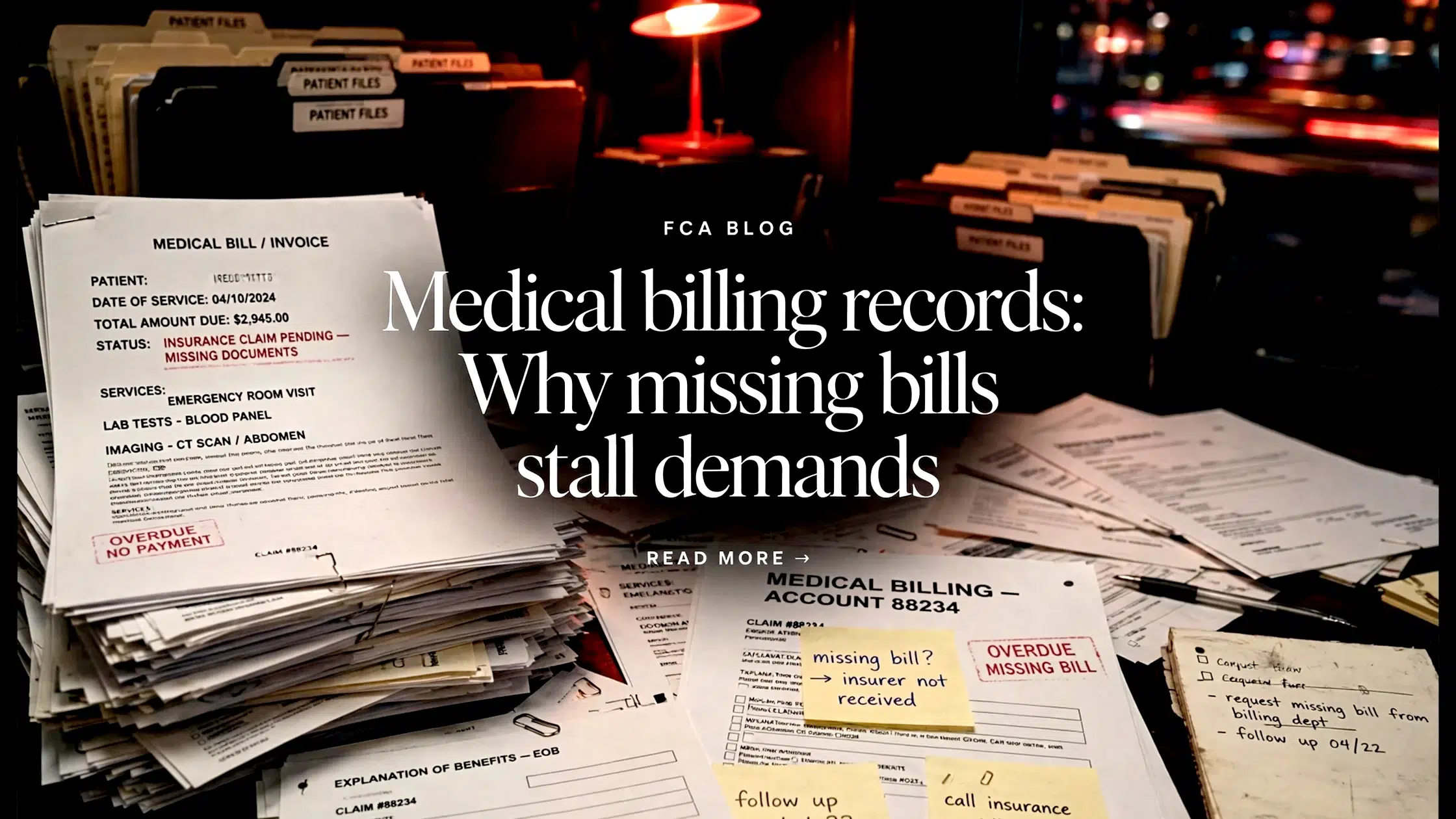
Treatment notes prove the injury, but billing records prove the dollar amount. The medical billing records personal injury firms collect show what each provider charged, what insurers paid, and what balance remains. When those records have gaps, the demand cannot support its medical damages, and adjusters discount the claim or stall it.
What’s the Difference Between Medical Records and Billing Records?
Medical records document what happened to the patient: symptoms, diagnoses, procedures, and treatment plans. Billing records document what that care cost, how the provider coded it, who paid, and what remains owed. A demand needs both, because one proves the injury and the other proves the number attached to it.
A chart can run hundreds of pages and still say nothing about price. A radiology report may confirm a herniated disc, but it does not tell the adjuster whether the MRI cost a few hundred dollars or a few thousand, whether health insurance paid part of it, or whether the provider still waits on a balance.
Chart notes still carry real weight, and medical records in personal injury cases shape how an adjuster views causation, treatment, and prognosis. Billing documents finish the picture by turning that story into a figure the adjuster can evaluate.
Offices also release these two sets of documents on different schedules. The clinical file often arrives first, which makes the file look complete. The damages section then rests on one lump-sum figure from a summary statement, and a careful adjuster questions that figure first.
Why Do Incomplete Medical Billing Records Weaken a Personal Injury Demand?
Incomplete bills leave the medical specials unverified, so the adjuster can challenge or ignore the figures. They also hide whether a charge was billed, paid, or written off, and that distinction often controls what a plaintiff can recover. A single missing provider can drop an entire line item from the evaluation.
The reason traces to Howell v. Hamilton Meats & Provisions, a California Supreme Court decision. Under Howell, a California plaintiff whose provider accepted an insurer’s payment as satisfaction generally cannot recover the higher billed amount. Recovery for past medical expenses is limited to the lesser of the amount paid or incurred and the reasonable value of the services. Consider a hypothetical surgery billed at $48,000 where the insurer paid $14,000 and the provider wrote off the rest. The paid figure, not the billed figure, becomes the starting point for the demand.
The Pebley exception changes the analysis for some patients. In Pebley v. Santa Clara Organics, a California Court of Appeal addressed a plaintiff who chose to treat on a lien basis instead of through insurance. The court allowed the plaintiff to be treated as uninsured and to present the full billed amounts as evidence of reasonable value. The defense can still contest reasonableness with expert testimony, so the bills must show clean charges, codes, and dates of service.
Lien-based treatment also raises questions about balances and reductions, and how medical liens work in California explains the mechanics. Cases differ, so firms and plaintiffs should ask their attorney which rule applies to each provider before the demand goes out.
Which Records Should Firms Request From Each Provider?
Firms should request itemized medical bills, the CMS-1500 or UB-04 claim forms, a payment ledger, and a custodian of records declaration from every provider. Together, those documents show what the provider charged, what it received, and whether the records are authentic. Skipping any one of them invites questions at the demand stage.
- Itemized medical bills: line-by-line charges with procedure codes, dates of service, and provider names. A summary statement with one total does not do this job.
- CMS-1500 claim forms: the standard form physicians, clinics, and other professional providers use to bill insurers.
- UB-04 claim forms: the standard form hospitals and surgical facilities use for facility charges.
- Payment ledger: payments received, adjustments, write-offs, and the remaining balance. This supplies the paid-versus-billed data that Howell v. Hamilton Meats makes relevant.
- Custodian of records declaration: a signed statement that the provider keeps the records in the regular course of business, which typically lets the firm authenticate them without calling a witness.
Providers that treat on a lien basis may never have submitted claims to an insurer. In that case, ask for the itemized bill and ledger in place of the claim forms. Send one medical records request per provider location that lists every item by name, so the office does not release a chart and consider the job finished.
Why Does Retrieval Take So Long?
Retrieval slows down at three points: HIPAA authorizations that a provider rejects, backlogs in the provider’s records office, and treatment spread across several locations. Each problem adds days or weeks, and they often stack. Most delays start with the request itself, not with the provider’s willingness to help.
A provider can refuse an unsigned authorization, expired, missing required elements, or vague about what the firm wants. The firm then corrects the form and restarts the clock. Records departments also handle requests from insurers, courts, and patients alongside attorney requests, and many use outside release-of-information vendors that run their own queues. Billing and records often sit in separate departments, so a chart can arrive while the itemized bills wait in another line.
A plaintiff who sees an emergency room, an orthopedist, an imaging center, and a physical therapist creates four records custodians and several billing offices. Hospitals may keep facility bills and physician bills in different systems. Medical records retrieval works best when firms treat each provider as its own small project with its own deadline.
A subpoena is not always necessary. A valid signed authorization from the patient usually gets records released, and a subpoena typically enters the picture when a provider does not respond or when litigation requires formal production. Ask your attorney which route fits each provider.
How Can Firms Track Requests Without Chasing Staff?
Firms can track requests with a single log that records each provider, location, request date, and follow-up date. A fixed follow-up schedule and a checklist for each production replace repeated phone calls. In most cases, the log also shows exactly which bills are missing before the demand goes out.
- Log every request by provider and location, with the date sent, the delivery method, and the authorization version used.
- Set follow-up dates at regular intervals and assign one person to each request.
- Check every production against the checklist above and record what is missing the day it arrives.
- Compare the dates of service on the bills with the treatment notes to catch gaps in either set.
- Send an updated medical records request shortly before the demand so late charges and final balances appear in the file.
Records should typically run through the end of active treatment, or through the most recent visit if treatment continues, and a final refresh catches late charges. Ask your attorney whether the demand should wait for treatment to conclude.
Firms that lack the staff time for this routine sometimes hand it to a medical records retrieval company that keeps follow-up on a set schedule.
What You Should Know
Complete billing documentation turns a well-supported injury claim into a well-supported demand. Request itemized bills, claim forms, ledgers, and custodian declarations from every provider, track each request, and refresh the set before the demand goes out.
If records costs or slow treatment payments strain a file, Fund Capital America can discuss medical lien funding and case cost funding in the states where we operate, subject to review. Our team also supports firms with medical records retrieval so complete bills reach the file before the demand does.
This article is general information, not legal advice. HIPAA protects medical records as protected health information, and providers release them only with a valid patient authorization or other legal process.
Who is Fund Capital America?
Since 2006, Fund Capital America (FCA) has provided pre-settlement funding to plaintiffs in personal injury and accident cases. FCA has served thousands of law firms and tens of thousands of clients, and it supports law firms and medical providers with case services from the start of a case to the final settlement.
Fund Capital America’s Services
Along with pre-settlement funding, FCA helps injury victims, law firms and medical providers with:
- Legal Funding
- Policy Limits Search
- Investigations
- Language Services
- Law Firm Services
- Medical Legal Funding
- Medical Records Retrieval
- FCA MedConnect
Apply in About 5 Minutes
Fill out the application: it takes about 5 minutes to share the details of your case.
Get prequalified: our team reviews your application and gets back to you quickly, often within hours.
Questions? Call us at (855) 870-2274. ¡Hablamos Español!
Don’t let financial stress keep you from focusing on your recovery. Apply now for a lawsuit cash advance.