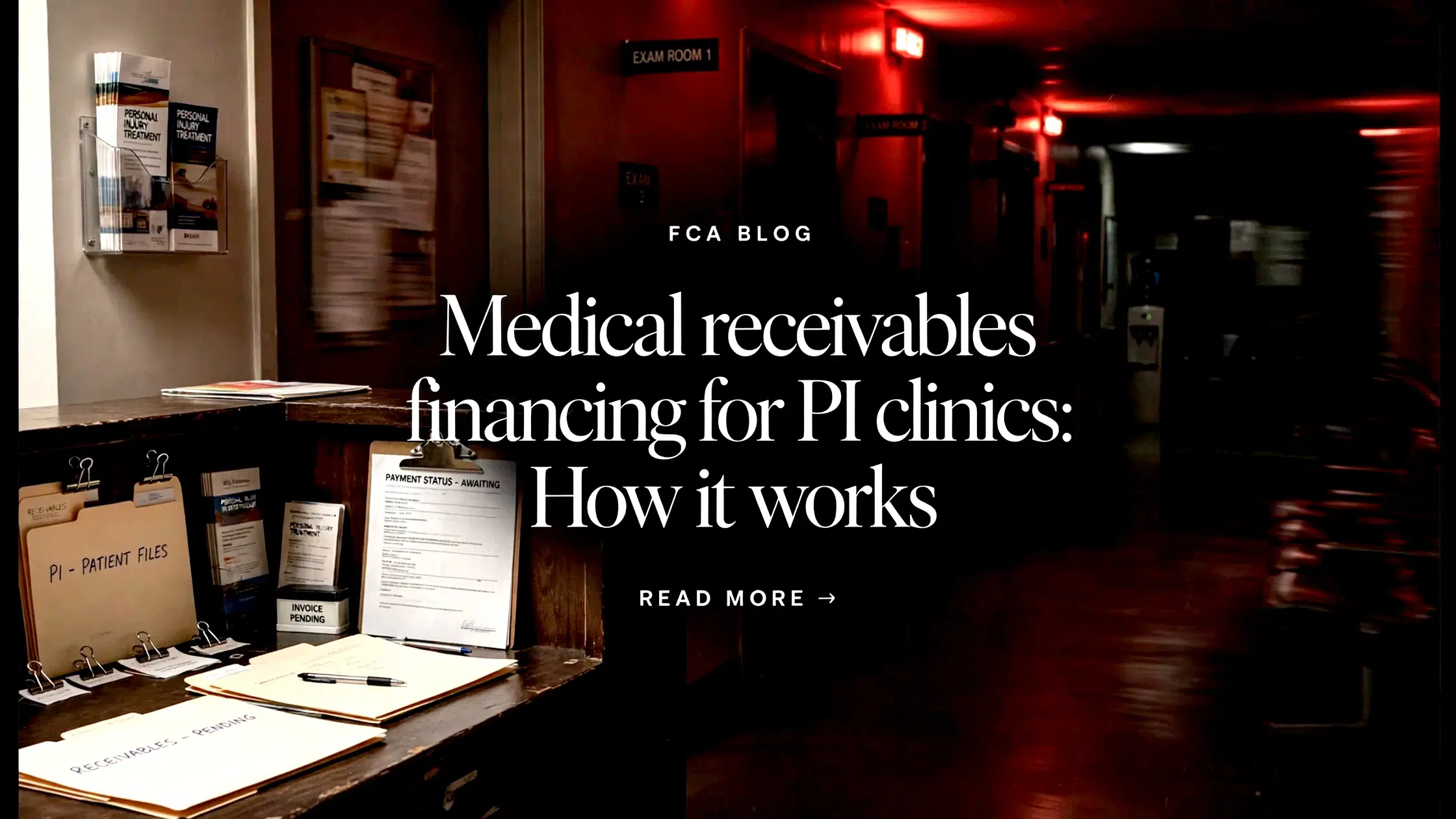
A PI clinic can deliver care today and wait months to get paid for it. Medical receivables financing gives that clinic an advance on its unpaid lien-based invoices, subject to review, so payroll, rent, and supplies stay covered while cases work toward settlement.
Lien-based clinics often carry months of unpaid receivables, and the balance grows with every new patient. Financing changes the timing, not the underlying case. The clinic receives part of the money now, and the case keeps moving on its own schedule.
Why Do Busy PI Clinics Still Struggle With Cash Flow?
Most PI clinics treat patients on a lien basis, so they provide care now and collect only after the case resolves. Payroll, rent, and supply bills keep arriving every month while those receivables wait. That mismatch squeezes even a clinic with a full schedule.
Consider a hypothetical clinic that bills $40,000 a month in lien-based care and spends $30,000 a month on overhead. Suppose none of those cases settle for six months. The clinic then holds $240,000 in unpaid receivables and has covered $180,000 in expenses without collecting on those invoices.
Settlement timing makes the gap harder to predict. Recovery periods, insurer disputes, and negotiations all affect how long a case takes, which explains why personal injury settlements take so long. A California clinic has no control over that timeline, and traditional bank financing often fits poorly because banks may want a long operating history and may not understand lien-based receivables.
What Is Medical Receivables Financing, and How Does It Differ From Selling Liens?
Under this approach, a clinic converts unpaid PI invoices into working capital by assigning them to a funding company. The clinic typically receives an advance up front, then the remaining balance, minus the funding fee, after the invoice is paid. The industry often calls this structure medical factoring.
The difference from selling liens comes down to who keeps the remaining balance. In a straight lien sale, a buyer typically purchases the lien at a fixed discount, and the clinic’s role usually ends with that payment. In factoring, the clinic assigns the invoice, receives an advance, and typically gets the rest, less the funding fee, once the invoice is paid. Terms vary by funding company, so the written agreement controls.
Some providers search for medical accounts receivable financing when they want the same result: turning a ledger of earned invoices into cash without waiting for each case to close. Personal injury receivables financing adds one complication, because payment depends on the outcome of the underlying case rather than a standard insurance billing cycle. That is why funding companies review the case file along with the invoice.
Which Receivables Qualify for Funding?
In most cases, qualifying receivables come from lien-based treatment where the patient has an attorney, the case is active, and the clinic documents its charges thoroughly. Attorney acknowledgment carries significant weight. Every invoice is subject to review, so qualification varies from file to file.
Funding companies commonly look at a few core factors before they advance funds:
- Attorney acknowledgment: A signed lien or written confirmation from the patient’s attorney that the office knows about the provider’s lien.
- Documentation: Itemized billing, treatment notes, a signed lien agreement, and records that tie the care to the injury.
- Case stage: A file closer to resolution may carry less timing uncertainty, though earlier-stage cases can still qualify, subject to review.
- Billing quality: Charges that reflect reasonable, customary rates tend to hold up better when lien reductions come up.
Because personal injury receivables financing ties back to the strength of the case, clinics that keep organized, complete files usually move through review more smoothly.
How Is It Different From Medical Lien Funding?
Receivables financing advances cash to the clinic against invoices it has already earned. Medical lien funding typically helps a patient get treatment, such as surgery, when a facility will not carry the cost on a lien alone. One supports the provider’s cash flow, and the other supports the patient’s access to care.
Both address a timing problem, but they start from different places. Receivables financing begins with the invoices a clinic already holds. Lien funding begins with a plaintiff’s treatment needs and the case behind them. Some practices use both, depending on whether the pressure comes from unpaid balances or from patients who need care they cannot yet afford. For a closer look at the legal side, our guide on how medical liens work in California covers the framework providers rely on.
How Can Clinics Use the Working Capital?
Most clinics put the funds toward staffing, equipment, and the overhead that supports a growing patient base. How you spend them is a business decision for your practice and your financial advisors.
Payroll comes first for most clinics. Working capital can cover current staff and support new hires, such as front-desk coordinators, medical assistants, or billing specialists who keep lien files organized.
Equipment is another common use. A clinic may add diagnostic or therapy equipment, or update its practice software, to expand the services it offers under one roof.
Capacity matters too. Every new lien-based patient adds to outstanding receivables, so a clinic that cannot carry more balances may have to limit PI referrals from attorneys. Steady working capital can give a California clinic room to accept more of those patients, and medical accounts receivable financing can make monthly planning easier because funding ties to invoices the clinic already holds.
When a patient needs treatment, the clinic cannot carry on a lien; Fund Capital America’s medical legal funding can help keep care moving.
What Should Providers Ask Before Signing?
Ask how the funding fee works, whether the agreement is recourse or non-recourse, and how the funding company will notify patients’ attorneys. Get every term in writing, and have your own attorney review any medical factoring agreement before you sign. Terms vary by funding company, so the signed document controls.
Use these questions as a starting point:
- How does the funding fee work, and what comes out of the final balance?
- Is the arrangement recourse or non-recourse, and what does that mean if a case produces no recovery?
- When and how will you notify the patient’s attorney?
- How do you handle a lien reduction at settlement?
- How do you protect patient records under HIPAA?
- Are there other fees, minimum volumes, or exclusivity terms?
Providers often wonder whether the attorney needs to know. In most cases, yes. Funding companies typically notify the attorney of record that the receivable has been assigned, because the attorney’s office handles the settlement funds that pay the invoice. Ask for the notice process in writing so you can give attorney offices a heads-up before the notice arrives.
Providers also ask what happens if a case settles low. A low settlement often leads to negotiation over lien amounts, and agreements treat reductions differently. Some leave the clinic responsible for a shortfall, while others adjust the final balance. Ask for a worked example that uses a real reduction scenario, and take any questions about how a reduction affects the patient’s case to your own attorney.
What You Should Know
Lien-based care creates a timing gap, and receivables financing closes part of it by turning earned invoices into working capital sooner. Strong documentation, attorney acknowledgment, and clear terms usually decide how smoothly the process goes. Funding is subject to review, and amounts and timelines vary by case.
Fund Capital America can review your receivables and explain how medical receivables financing and medical lien funding might fit your practice. Providers in California and the other states where we operate can call (855) 870-2274 to get started.
Fund Capital America is not a law firm and does not provide legal advice. Funding is subject to review and approval, and amounts and timelines vary by case. Fund Capital America handles medical records and provider information in accordance with HIPAA.
Who is Fund Capital America?
Since 2006, Fund Capital America (FCA) has provided pre-settlement funding to plaintiffs in personal injury and accident cases. FCA has served thousands of law firms and tens of thousands of clients, and it supports law firms and medical providers with case services from the start of a case to the final settlement.
Fund Capital America’s Services
Along with pre-settlement funding, FCA helps injury victims, law firms and medical providers with:
- Legal Funding
- Policy Limits Search
- Investigations
- Language Services
- Law Firm Services
- Medical Legal Funding
- Medical Records Retrieval
- FCA MedConnect
Apply in About 5 Minutes
Fill out the application: it takes about 5 minutes to share the details of your case.
Get prequalified: our team reviews your application and gets back to you quickly, often within hours.
Questions? Call us at (855) 870-2274. ¡Hablamos Español!
Don’t let financial stress keep you from focusing on your recovery. Apply now for a lawsuit cash advance.