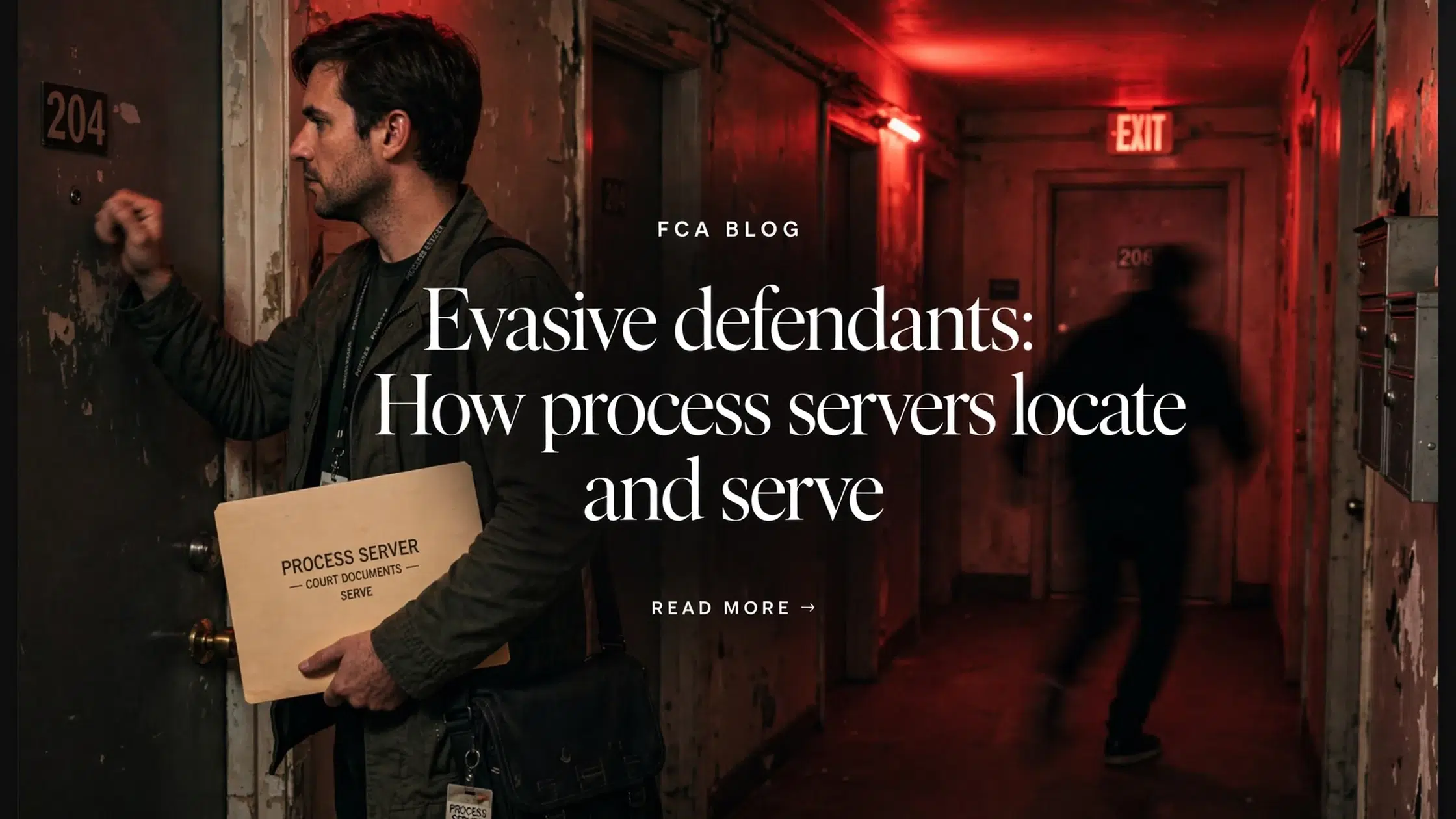
An unserved defendant stalls a personal injury case before it truly starts. Serving an evasive defendant in California takes three steps: locate the person through skip tracing and field work, attempt service diligently and document every try, then seek substituted service or a court-ordered alternative when personal delivery fails.
Service is the first real test of any case timeline. Until the defendant receives the summons and complaint, discovery stalls and settlement talks go nowhere. Attorneys carry idle case costs, and plaintiffs and medical providers wait longer for resolution.
Why does serving an evasive defendant in California stall a PI case?
The court generally cannot move a claim forward until the defendant receives proper service. Every failed attempt, missed deadline, or defective proof of service adds weeks to the timeline. For plaintiffs with mounting medical bills, that wait creates real financial pressure.
Court rules set deadlines for serving the complaint and filing proof of service, and a firm that misses them can face dismissal or sanctions. An evasive defendant makes those deadlines harder to meet. Common tactics include moving without updating records, ignoring the door, living behind gated access, or relying on roommates to say the person no longer lives there.
A flawed attempt costs even more. If a server leaves papers at the wrong address or skips the mailing step, the defendant can move to quash service, and the firm starts over. Plaintiffs who face these delays sometimes ask their attorneys about pre-settlement funding to cover treatment and living costs while the case waits.
How do investigators locate a hard-to-find defendant?
Investigators combine skip tracing, records searches, and field work to confirm where a defendant lives, works, and spends time. The goal is a verified current address, not just a last known one.
A solid locate effort usually layers three methods:
- Skip tracing uses commercial and public databases to connect a name to recent addresses, phone numbers, and associates.
- Records searches check property records, business filings, court dockets, and professional licenses for signs of where the defendant lives and works.
- Fieldwork includes neighborhood checks, conversations with neighbors, vehicle confirmation, and surveillance at likely times.
Each layer checks the one before it. A database hit means little until someone confirms the person actually lives there. Our guide on how skip tracing helps find a missing defendant covers the data side in more detail.
What counts as diligent effort before substituted service?
Diligence means the server made repeated, well-documented efforts to deliver the papers personally before turning to another method. California Code of Civil Procedure section 415.20 allows substituted service, which means leaving the papers with a competent adult at the defendant’s home or business and then mailing a copy, but only after those efforts fail.
The statute does not set several attempts. Many practitioners treat two or three attempts at a verified address, spread across different days and times, as a starting point. They add more when the facts suggest the defendant is avoiding contact. A single Tuesday afternoon stop rarely supports a diligence claim. Early mornings, evenings, and weekends all matter, because a defendant who works days is seldom home at noon.
Can a firm serve a defendant at work? Often yes. Personal service can happen wherever the server finds the defendant, and a workplace can also support service by leaving the papers with the person in charge and mailing a copy. The server still has to respect private areas and avoid a scene that could embarrass the defendant or draw a complaint.
Questions to ask your attorney include whether the current record supports substituted service yet or whether more attempts make sense.
When is service by publication an option?
Service by publication is a last resort, and it requires a court order under California Code of Civil Procedure section 415.50. The plaintiff must show the judge, usually through a sworn declaration, that reasonable diligence failed to locate or serve the defendant.
The judge decides whether the diligence record is strong enough. If it is, the order typically directs publication in a newspaper the court believes is most likely to reach the defendant, and it may require mailing a copy when an address is known. Weak records get denied, which sends the firm back to the field and adds more delay. Service by publication also takes several weeks to complete.
Publication carries risk after the fact, too. A defendant who never saw the notice can later challenge a judgment, so a thin declaration can undermine a result that took months to reach. A strong declaration depends on locating work and attempting logs, not on a form.
What documentation protects the proof of service?
A complete attempt log and a detailed declaration of diligence protect the proof of service. Each entry should show what the server did, when, and what the server saw, so a judge can follow the effort without guessing.
A useful attempt log includes:
- The date, time, and address of every attempt
- Who answered, what that person said, and a physical description
- Signs of occupancy, such as vehicles, lights, or mail
- Time-stamped photos of the address and any vehicles
- The records or search results that confirmed the address beforehand
- The server’s signed declaration tying it all together
The declaration should read like a timeline that a judge can follow without a phone call. A licensed process server who writes these records every day usually produces cleaner declarations than office staff who handle service on the side. Our overview of how professional process servers work shows how this record-keeping plays out in a real case.
When should a firm outsource service and locations?
A firm should outsource when the first round of attempts fails, the address stays unverified, or staff cannot spare the time for field work. Early outside help can save the time that missed attempts would otherwise cost.
Deadlines are the other trigger. If the service window is closing and the defendant still has not turned up, a specialist with locate tools and field experience gives the firm its best shot at a clean proof of service. Ask any provider about California registration requirements, how they document attempts, and whether the server can testify if the defendant challenges service. A process server who cannot support the record in court does the firm little good.
Cost matters too. Field work, mileage, and repeated attempts add to case costs. Firms that carry those costs while a case waits can ask about case cost funding, subject to review. Service and locates also sit alongside other tasks, such as records retrieval and interpreting, that many practices handle through outsourced law firm services.
What You Should Know
Serving a hard-to-find defendant comes down to three habits: verify the address, make diligent and documented attempts, and move to court-approved alternatives only when the record supports them. Strong service work protects the case timeline, and that protects everyone waiting on the outcome.
Fund Capital America helps personal injury attorneys with investigations, skip tracing, and service of process, and we also offer legal funding for plaintiffs and law firms when a case runs long, subject to review. If a defendant has gone quiet on your case, our team can talk through the next steps with you.
This article provides general information, not legal advice. Statutes and court rules change, so confirm current requirements with your attorney before you act.
Locate work that involves driver records or contact outreach follows applicable privacy laws, including the Driver’s Privacy Protection Act and the Telephone Consumer Protection Act.
Who is Fund Capital America?
Since 2006, Fund Capital America (FCA) has provided pre-settlement funding to plaintiffs in personal injury and accident cases. FCA has served thousands of law firms and tens of thousands of clients, and it supports law firms and medical providers with case services from the start of a case to the final settlement.
Fund Capital America’s Services
Along with pre-settlement funding, FCA helps injury victims, law firms and medical providers with:
- Legal Funding
- Policy Limits Search
- Investigations
- Language Services
- Law Firm Services
- Medical Legal Funding
- Medical Records Retrieval
- FCA MedConnect
Apply in About 5 Minutes
Fill out the application: it takes about 5 minutes to share the details of your case.
Get prequalified: our team reviews your application and gets back to you quickly, often within hours.
Questions? Call us at (855) 870-2274. ¡Hablamos Español!
Don’t let financial stress keep you from focusing on your recovery. Apply now for a lawsuit cash advance.