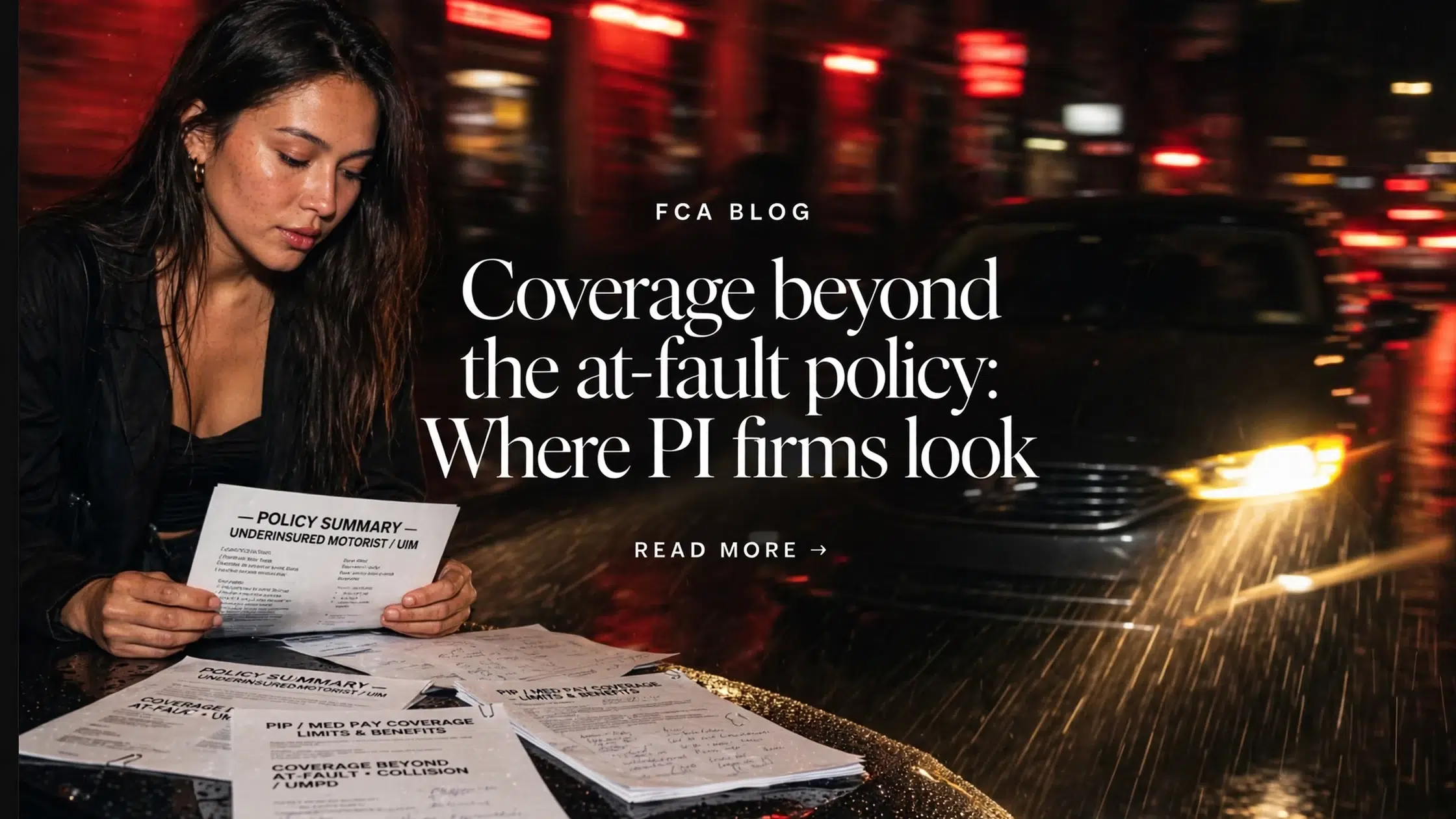
When a claim’s damages outgrow the at-fault driver’s policy, the case is not automatically capped at that number. Firms that know how to look for additional insurance coverage in personal injury cases often uncover more sources of recovery, from the client’s own underinsured motorist coverage to umbrella or excess policies and shared liability through an employer or vehicle owner.
What happens when damages exceed the at-fault policy?
A claim is not limited to the at-fault driver’s policy just because that number comes in low. Firms can still pursue the client’s own coverage, a policy layered above the at-fault party’s, or any other party who shares legal responsibility for the crash.
State minimum liability limits, including California’s, were never designed to cover a serious injury. A client with months of treatment, lost wages, and ongoing care can reach that ceiling fast, and the at-fault driver’s policy is rarely the only source of recovery in that situation. The work at this stage is less about accepting the number on the declarations page and more about mapping every policy that could legally respond to the loss. Many firms treat this step as the moment damages exceed insurance limits, rather than a dead end, and start building out a fuller coverage picture before settlement talks begin.
A thorough review at this stage typically covers:
- The client’s own policy, including any UM/UIM protection
- Umbrella or excess policies tied to the at-fault driver or a third party
- Employer liability, when the at-fault driver was working at the time
- Vehicle owner liability, when someone other than the driver owned the car
- Commercial or rideshare coverage, when a business vehicle was involved
Working through this list early gives the firm a realistic view of total exposure before any demand goes out, rather than discovering additional insurance coverage midway through negotiations.
Can the client’s own UM/UIM coverage apply?
Yes. If the at-fault driver’s policy does not fully cover the damages, the injured party’s own underinsured motorist coverage can often make up part of the difference. California requires insurers to offer this coverage on auto policies, though a policyholder can decline it in writing, so it is worth confirming it was actually carried.
At a general level, UM/UIM coverage in California works on an offset basis: UIM benefits typically get reduced by what the claimant already recovered from the at-fault driver’s policy, rather than stacking fully on top of it. The exact math depends on the policy language and the facts of the case, so this is a question to raise with the client’s insurer or with coverage counsel rather than something to assume from a declarations page alone. For firms new to this step, confirming whether the client carries this coverage, and at what limits, is worth doing early rather than after a demand has already gone out.
A client may not remember whether they carry this protection, and a dusty declarations page is not always easy to track down. Requesting a copy directly from the client’s own carrier, early in the case, is a simple way to confirm whether this piece of additional insurance coverage is in play before it becomes relevant to a demand.
When does an umbrella or excess policy come into play?
An excess insurance policy sits above a standard auto or general liability policy and activates once the underlying limits are used up. These policies are common for business owners, property owners, and people with significant personal assets, and they can meaningfully expand what is available to resolve an accident claim.
An umbrella policy works similarly but typically covers a broader range of situations than one specific excess policy tied to a single underlying line. When a defendant or their employer carries one, an umbrella policy can turn what looked like a capped accident claim into one with real additional exposure. Confirming whether an excess insurance policy or umbrella policy exists usually means asking directly, since neither tends to show up in a quick lookup the way a standard auto policy does.
When is an employer or vehicle owner also liable?
An employer can be liable for a crash caused by an employee who was acting within the course and scope of employment, and a vehicle owner can be liable when they gave someone permission to drive under permissive use rules. Either path can add another policy, and another source of recovery, beyond the driver’s own coverage.
Course and scope questions often turn on what the driver was doing at the time: running a work errand looks different from a personal detour on the way home, even in the same vehicle. Permissive use works differently, since it follows the vehicle rather than the relationship between driver and owner, so a car owned by a third party can pull that owner’s policy into the claim even without any employment connection at all. A family member’s car, a friend’s truck, or a company vehicle loaned out for the weekend can all raise this same question. These are fact-specific determinations, so firms should treat them as questions to raise with the attorney handling the case rather than conclusions to draw from the police report alone.
What about commercial and rideshare policies?
Commercial auto and rideshare policies often carry higher limits than a typical personal auto policy, and rideshare companies layer additional coverage on top of a driver’s personal policy depending on what the driver was doing at the moment of the crash.
A rideshare driver waiting for a ride request, actively on the way to pick someone up, and transporting a passenger can each fall under different coverage tiers from the same rideshare company. Working through insurance after a car-sharing or rideshare accident usually means confirming the driver’s app status at the time of the crash before assuming which policy applies. Commercial policies raise a similar question: a delivery van or contractor’s truck may carry a commercial policy with limits well above a personal policy, but only if the vehicle was being used for business purposes when the crash happened.
These tiered policies are one of the more overlooked forms of additional insurance coverage in personal injury claims, largely because the underlying personal auto policy looks ordinary at first glance. Pulling the trip or dispatch record for the relevant time window is usually the fastest way to settle which tier was active.
How does a liability limit search speed this up?
A policy limits search identifies how much coverage actually exists before a firm spends weeks on discovery trying to find out. It lets attorneys prioritize where to focus negotiation and, if needed, litigation strategy early in a case rather than guessing at exposure.
Instead of waiting on formal discovery to confirm what is available, firms can request a policy limits search that checks for the at-fault policy, any underinsured motorist coverage, and other liability sources tied to the crash. Fund Capital America’s policy limits search service is built around exactly this step, surfacing what coverage exists so the firm can decide how to proceed with full information rather than partial guesses. A faster answer here does not replace legal strategy, but it does give the attorney more to work with earlier in the case.
What You Should Know
Damages that exceed the at-fault policy are a starting point for a broader coverage review, not the end of the case. Underinsured motorist coverage, excess and umbrella policies, employer and vehicle owner liability, and commercial or rideshare coverage can all expand what is actually available, and a policy limits search is often the fastest way to find out which of these apply. Fund Capital America supports plaintiff-side firms working through these coverage questions by providing case cost funding alongside this search service, so attorneys can keep moving a case forward while the fuller insurance picture comes into focus.
Who is Fund Capital America?
Since 2006, Fund Capital America (FCA) has provided pre-settlement funding to plaintiffs in personal injury and accident cases. FCA has served thousands of law firms and tens of thousands of clients, and it supports law firms and medical providers with case services from the start of a case to the final settlement.
Fund Capital America’s Services
Along with pre-settlement funding, FCA helps injury victims, law firms and medical providers with:
- Legal Funding
- Policy Limits Search
- Investigations
- Language Services
- Law Firm Services
- Medical Legal Funding
- Medical Records Retrieval
- FCA MedConnect
Apply in About 5 Minutes
Fill out the application: it takes about 5 minutes to share the details of your case.
Get prequalified: our team reviews your application and gets back to you quickly, often within hours.
Questions? Call us at (855) 870-2274. ¡Hablamos Español!
Don’t let financial stress keep you from focusing on your recovery. Apply now for a lawsuit cash advance.