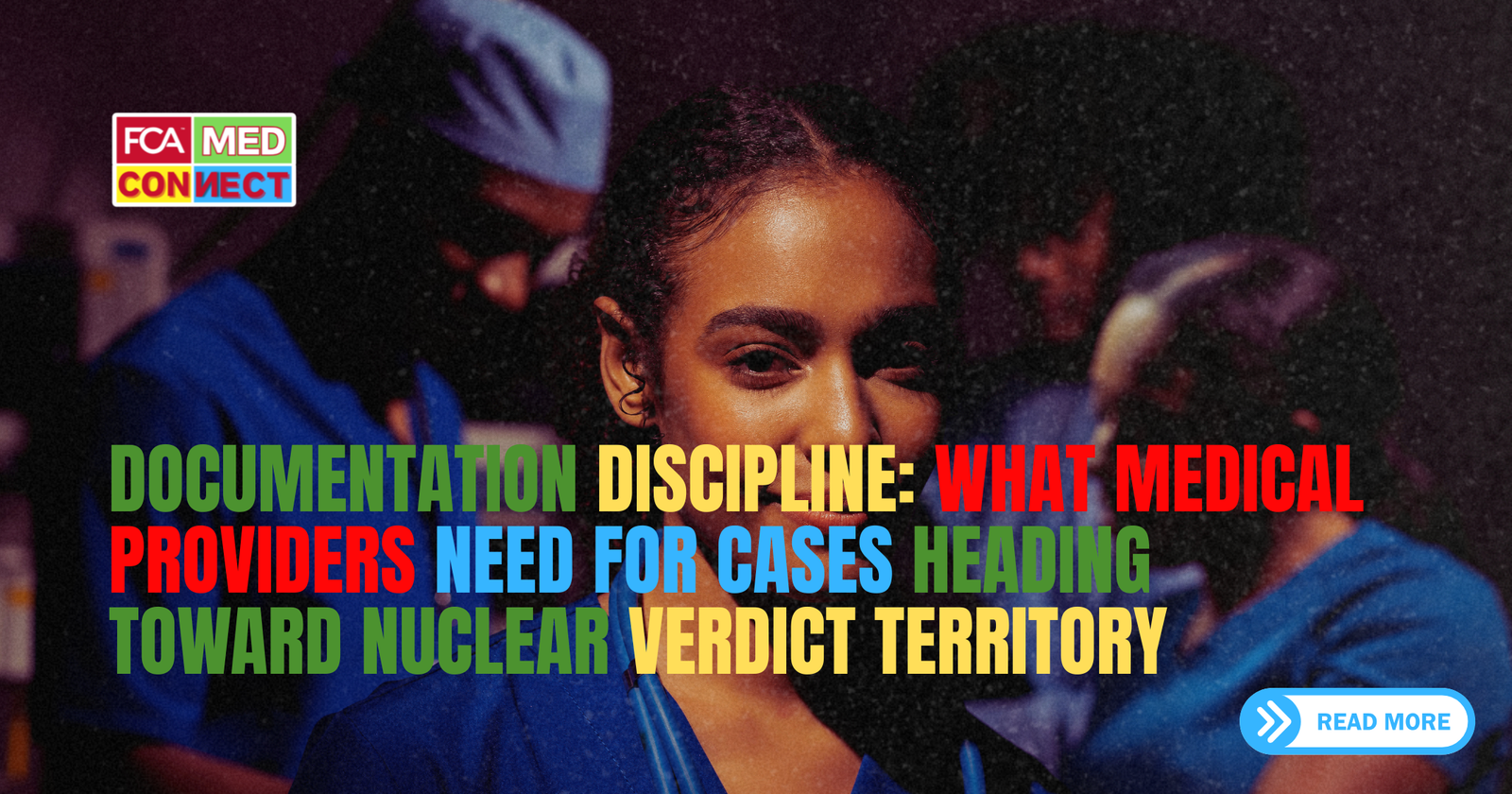
A single missing progress note can undo months of careful treatment once a case reaches trial. For California providers treating patients in high-value personal injury claims, that reality changes how every chart should be built from the first visit onward.
Medical documentation in personal injury cases is not a formality. It is the record that attorneys, insurers, and juries will use to understand what happened to a patient and why the treatment path made clinical sense. When a case involves significant injuries and the potential for a large award, often described informally as a nuclear verdict, meaning a jury award far exceeding what the facts alone might predict, the documentation supporting that claim faces a level of scrutiny that smaller cases rarely receive.
This is not a claim that better records produce bigger verdicts. Documentation does not create damages. What it does is protect the credibility of the treating provider and the accuracy of the medical narrative, regardless of how large or small the case turns out to be. High-value cases simply raise the stakes for any gap, inconsistency, or vague entry that would otherwise go unnoticed.
Why Documentation Carries More Weight in High-Value Cases
Larger cases draw closer scrutiny of every record. When damages are substantial, defense counsel and their retained experts read charts line by line, looking for anything that contradicts the treatment story or suggests the injury was less severe than claimed. A record that would pass without comment in a modest case can become a central exhibit in a high-value one.
Gaps and inconsistencies become points of attack. A missed follow-up, a symptom described differently at two visits, or a diagnosis that shifts without explanation gives opposing counsel an opening. These gaps rarely sink a case outright, but they force the treating provider to spend deposition time explaining discrepancies instead of confirming findings.
Clean records support the treating provider’s credibility. Juries and adjusters weigh a provider’s opinion partly on how organized and consistent the underlying chart appears. Records for litigation that read clearly, follow a logical progression, and use consistent language make the provider’s testimony easier to trust.
What Disciplined Records Look Like
Strong documentation for litigation shares a few consistent traits across specialties and practice types. These are not new standards invented for personal injury work. They reflect the same clinical discipline that supports good patient care, applied with an awareness that the chart will eventually be reviewed by people outside the practice.
- Contemporaneous notes tied to specific findings. Notes written at or near the time of the visit, referencing objective findings such as range of motion, imaging results, or specific patient-reported symptoms, carry more weight than notes reconstructed later from memory.
- Consistent terminology across visits. Using the same clinical language for the same condition throughout the treatment period prevents confusion about whether a symptom changed or simply got described differently.
- Clear links between injury, treatment, and progress. Each entry should connect back to the original mechanism of injury and show how the treatment plan responds to the patient’s actual progress, not a generic protocol applied without documentation of why.
Providers who treat patients tied to litigation often benefit from a medical chronology summary that organizes the full treatment history into a single, reviewable timeline. This kind of support does not replace the original chart, but it helps confirm that the documentation tells a consistent story before anyone else reads it that way.
Building the Habit Across a Practice
Documentation standards fail most often not because a provider lacks clinical skill, but because the practice has no system for catching gaps before they matter. Building that system across a practice, rather than relying on individual providers to remember every detail, is what makes treatment documentation standards sustainable over time.
Standardize templates so records are complete by default. A template that prompts for mechanism of injury, objective findings, and treatment rationale at every visit removes the guesswork and reduces the chance that a busy day results in a thin note.
Review charts for gaps before they reach an attorney. A brief internal review, even a quick read-through by another staff member, can catch missing signatures, incomplete date ranges, or terminology that drifted partway through treatment.
Use chronology support to catch inconsistencies early. Reviewing how a medical chronology affects a case gives providers a useful lens for spotting problems from the outside, the same way an attorney or claims adjuster eventually will impact the Medical Chronology on Your Case
Where Documentation Intersects with the Rest of the Case
Providers do not build these records in isolation. Attorneys handling high-value claims are watching the same documentation for the same reasons, since the strength of the medical record often shapes how a case gets valued and negotiated long before a jury ever sees it. Providers who understand that connection tend to produce charts that hold up better under later scrutiny, not because they are trying to influence the outcome, but because they understand what a complete record actually needs to contain.
This matters just as much for providers extending treatment under a lien arrangement while a case is pending. Medical liens depend on the same documentation discipline described here, since a lien is only as strong as the record supporting the treatment it covers. A provider with thorough, consistent charting is in a stronger position regardless of how the underlying funding for that care is structured.
None of this requires providers to write defensively or pad their notes with unnecessary detail. It requires writing accurately, consistently, and completely, the same standard that supports good patient care in the first place. The difference in a high-value case is simply that the margin for error narrows considerably.
What You Should Know
Documentation for nuclear verdicts is really documentation for any case where the stakes are high enough to draw close scrutiny, and California providers treating serious injuries should build that discipline into every chart rather than reserving it for cases that already look significant. Contemporaneous notes, consistent terminology, and a clear clinical narrative protect both the patient’s case and the provider’s credibility.
Fund Capital America works with California treating providers and law firms on medical lien funding and chronology support that help keep documentation organized and accessible throughout a case. If your practice needs support building records that hold up under review, reach out to Fund Capital America to discuss how these services fit your patients’ cases.
Who is Fund Capital America?
Since 2006, Fund Capital America (FCA) has provided pre-settlement funding to plaintiffs in personal injury and accident cases. FCA has served thousands of law firms and tens of thousands of clients, and it supports law firms and medical providers with case services from the start of a case to the final settlement.
Fund Capital America’s Services
Along with pre-settlement funding, FCA helps injury victims, law firms and medical providers with:
- Legal Funding
- Policy Limits Search
- Investigations
- Language Services
- Law Firm Services
- Medical Legal Funding
- Medical Records Retrieval
- FCA MedConnect
Apply in About 5 Minutes
Fill out the application: it takes about 5 minutes to share the details of your case.
Get prequalified: our team reviews your application and gets back to you quickly, often within hours.
Questions? Call us at (855) 870-2274. ¡Hablamos Español!
Don’t let financial stress keep you from focusing on your recovery. Apply now for a lawsuit cash advance.